Lower back pain for active people: how to get moving again
For active people, lower back pain can feel especially disruptive. It is not just pain. It is interruption.
It can stop a workout, a tennis match, a dance class, a trip, or even something as basic as getting out of bed without bracing yourself first. For people who live alone, it can feel even more unsettling. For people with a full calendar, it can be frightening how quickly one back strain can change the shape of a week.
At RegenClinic, we are increasingly speaking to people through a more active lens. Not just patients with diagnoses, but people who understand how deeply movement is tied to quality of life. That includes younger athletes, weekend gym-goers, recreational tennis players, and people like Hildy, who is 95 and still goes to the gym several times a week because her independence matters.
That is the audience for this piece: people who need to move, and who want a clear plan when lower back pain suddenly gets in the way.
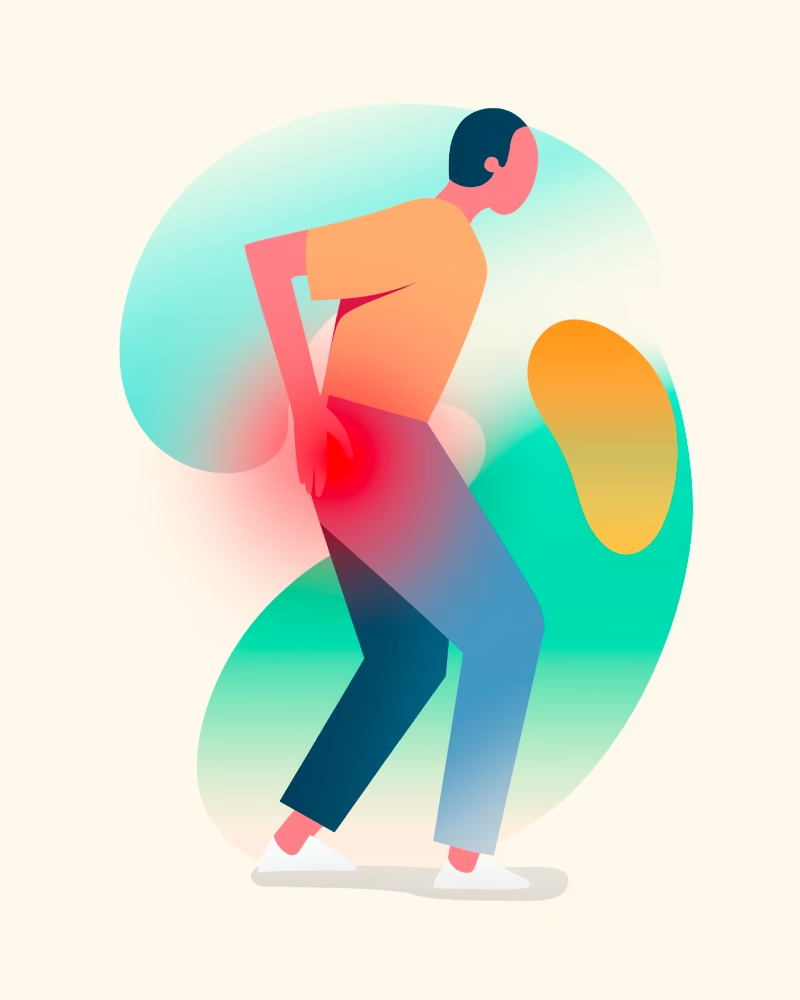
What “mechanical low back pain” usually means
The THOR protocol for mechanical low back pain covers a broad group of common problems, including facet irritation, muscle spasm, ligamentous strain, postural low back pain, recurrent low back pain, and low back strain. In other words, the kinds of injuries and flare-ups that often come from lifting, twisting, training, overreaching, or simply asking a bit too much of an already tired system.
This kind of back pain is common, but that does not make it minor.
When the lower back locks up, pain can be hard to localize and surprisingly difficult to calm down. It may feel sharp in one moment, broad and diffuse in the next, and it often creates a sense of instability that makes people hesitant to move at all. For active people, that uncertainty is often as stressful as the pain itself.
Why early treatment matters
One of the clearest messages in the THOR protocol is timing: for acute low back pain, treatment should begin as soon as possible after onset. The recommended schedule is ideally twice a week for 1 to 3 weeks depending on symptoms, followed by weekly sessions for another 1 to 3 weeks if needed. For chronic cases, the protocol recommends at least two sessions per week for 4 weeks, then weekly for 3 weeks, and then treatment in response to symptoms.
This matters because back pain often becomes more complicated the longer it lingers. Muscle guarding increases. Movement patterns change. Trigger points build. People start compensating, and those compensations can create new pain on top of the original strain.
For an active person, having a system in place early can make recovery feel much less chaotic.
What the research says about laser therapy for low back pain
Red light therapy is a non-invasive light-based treatment affecting connective tissue cells, accelerate connective tissue repair, and acting as an anti-inflammatory agent. It also notes that these therapies use specific wavelengths, generally between 632 and 904 nm, for musculoskeletal conditions.
In plain English, that means the goal is not just to numb pain. It is to support the tissue environment around the injury: calm inflammation, improve local healing conditions, and reduce the muscular tension and trigger points that often keep back pain going.
That distinction matters to active people. Most do not simply want the pain turned down for a few hours. They want to recover in a way that helps them trust their body again. At RegenClinic, we do not present laser therapy as a miracle fix for every case of back pain. The evidence suggests it helps reduce pain, especially in the short term, but it works best when understood as part of a broader recovery strategy.
What Treatment Looks Like at RegenClinic
The THOR protocol is very practical. It does not just target the painful area, it works through several layers of the problem.
A typical approach includes:
- stimulating bilateral inguinal lymph nodes, along with sacral lymphatic regions, to support circulation and fluid movement
- treating affected facet joints, muscle spasm, tension, and ligamentous strain in the low back
- using analgesic treatment over the L3-S1 spinous processes and ipsilateral nerve root exits
- deactivating local myofascial trigger or tender points
That layered structure is one reason this kind of treatment can feel relieving even when the pain itself is vague or diffuse. Mechanical low back pain is often not one single point problem. It is a web of inflammation, spasm, nerve irritation, and guarding.
A sample plan for someone who has just strained their lower back
If someone tweaks their back at the gym, while lifting, during sport, or even reaching awkwardly at home, here is a sample RegenClinic-style plan based on the THOR protocol:
Week 1
Begin treatment as soon as possible. Ideally come in twice that week. Early sessions focus on circulation, inflammation, pain reduction, and calming down local spasm.
Weeks 2 to 3
Continue twice weekly if symptoms are still active. Treatments focus on the painful lumbar segments, surrounding muscle tension, and any associated trigger points.
Weeks 4 to 6
If pain is settling but the area still feels vulnerable, transition to weekly sessions to support recovery and reduce the chances of the issue dragging on.
If symptoms become chronic:
The THOR protocol recommends at least two treatments per week for 4 weeks, then weekly for 3 weeks, followed by maintenance based on symptoms. It also notes that in chronic low back pain, some analgesic treatment may be repeated after about 5 minutes in persistent cases that have not responded after 5 treatments.
As always, these are treatment guidelines, not one-size-fits-all rules. THOR itself notes that treatment intervals and duration may require adjustment based on individual response.
🌿 Relief matters, but so does confidence
What many people need most when their back goes out is not just pain reduction. It is reassurance that there is a plan.
Common painkillers do not always solve the problem in a meaningful way. They may blunt the experience without changing the underlying strain, guarding, or dysfunctional movement pattern. Having a treatment protocol in place can be a relief in itself.
It gives the injury a structure.
It gives the person a next step.
And it makes recovery feel possible again.
For active people, treatment is not just about getting rid of pain. It is about getting back to the life that pain interrupted.
At RegenClinic, that is the lens we want to keep building from: helping people protect their movement, their energy, and their independence through care that is grounded, evidence-informed, and designed for real life.
Call or text us at 250-208-4218
Email: hello@regenclinic.ca