Parkinson’s Disease, Red Light Therapy, and the Next Frontier of Research
Most people think of Parkinson’s disease as a dopamine problem. And that is part of the story. Parkinson’s disease is closely associated with the loss of dopamine-producing neurons in the brain. This contributes to many of the movement symptoms people recognize, including tremor, stiffness, slower movement, changes in gait, and balance challenges.
But researchers are increasingly looking at a bigger picture. A 2024 scientific review (Bicknell et al., 2024) explored photobiomodulation, also known as red light therapy and near-infrared light therapy, as a potential supportive therapy for Parkinson’s disease.
What makes this review interesting is that it does not frame Parkinson’s only as a dopamine issue. Instead, it looks at several deeper systems that may be involved in the disease process, including mitochondrial dysfunction, neuroinflammation, oxidative stress, α-synuclein accumulation, and the microbiome-gut-brain axis.
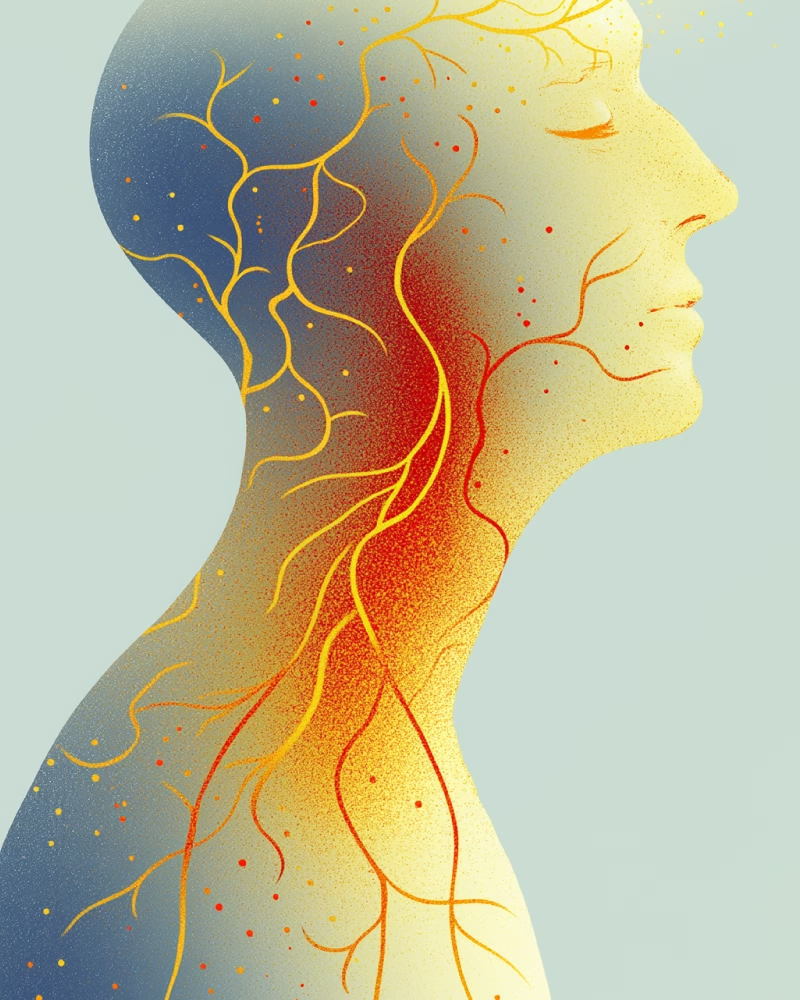
That may sound complex, but the basic idea is simple: Parkinson’s affects more than movement. It can involve the brain, nervous system, digestion, sleep, mood, energy, and the body’s inflammatory response.
Why Researchers Are Looking at Red Light Therapy for Parkinson’s
Photobiomodulation works by delivering specific wavelengths of red and near-infrared light to the body. One of the main proposed mechanisms is that this light interacts with mitochondria, the energy-producing structures inside our cells. More specifically, red and near-infrared light may influence cytochrome c oxidase, an enzyme involved in cellular energy production.
When mitochondria are better supported, cells may be better able to produce energy, regulate inflammation, and respond to stress. In Parkinson’s disease research, this matters because mitochondrial dysfunction and inflammation are both believed to play important roles in the disease process.
This is one reason researchers are studying red light therapy for Parkinson’s disease, not as a cure, but as a possible way to support some of the underlying systems involved in brain and body function.
Parkinson’s, Inflammation, and Cellular Energy
Parkinson’s disease is often discussed through the lens of dopamine, but the review highlights several other biological processes that may be important. These include:
Mitochondrial dysfunction
Oxidative stress
Neuroinflammation
Cellular energy decline
α-synuclein aggregation
Gut-brain axis changes
Photobiomodulation is being studied because it may help influence some of these processes. For example, red light therapy has been shown in many areas of research to support mitochondrial activity and modulate inflammation. In Parkinson’s disease, where neurons are under stress and cellular energy systems may be impaired, this becomes an especially interesting area of investigation.
The Gut-Brain Connection
One of the most fascinating parts of this review is its discussion of the microbiome-gut-brain axis. Many people think of Parkinson’s as a brain disease, but digestive symptoms are common and can appear years before diagnosis. Constipation, changes in gut function, inflammation, and microbiome imbalance are all being studied as possible parts of the Parkinson’s disease picture.
The review discusses the possibility that Parkinson’s may involve a two-way relationship between the gut and the brain. This is where red light therapy becomes even more interesting.
Researchers are not only studying light applied to the head. They are also studying “remote” photobiomodulation, where light is applied to other areas of the body, such as the abdomen or legs.
Why would light applied to the body affect the brain?
Researchers are still exploring this question, but possible explanations include systemic cell signalling, immune system effects, the vagus nerve, circulating factors, and changes through the microbiome-gut-brain axis. In other words, the brain may not be as separate from the rest of the body as we once imagined.
What the Research Shows So Far
The review summarizes a large number of preclinical studies, including cell and animal studies, where photobiomodulation showed promising effects. These included:
Support for dopamine-related neurons
Reduced signs of neuroinflammation
Improved mitochondrial function
Reduced oxidative stress
Improvements in movement-related signs
The review also summarizes a small number of human studies in people with Parkinson’s disease. Some of these studies reported improvements in motor and non-motor symptoms, including gait, balance, fine motor skills, sleep, cognition, smell, pain, and quality of life. This is encouraging, but it is still early and more research is needed.
🌿
For us, scientific reviews like this reflect a larger shift in how people are thinking about health. The body is not a collection of separate parts. The brain, gut, immune system, mitochondria, and nervous system are constantly communicating. Supporting one system may influence another. That is the frontier this research is beginning to explore.
For people interested in brain health, movement, aging, or neurological support, red light therapy or photobiomodulation may be worth learning more about.
Call or text us at 250-208-4218
Email: hello@regenclinic.ca